An approach to Congenital Heart Disease.
Approach to Congenital Heart Disease might appear challenging. We can always try making things simple by a structured approach. Using a clear, step‑by‑step clinical approach is one of the best ways to solve problems at the bedside. It also helps us learn better because we apply basic principles to real situations. This kind of principle‑based thinking is useful not just for one case, but for diagnosing and managing many different clinical problems.
Paediatric cardiology can be especially challenging because congenital heart diseases can appear at any age — from the first hours of life all the way into adulthood.
Let us have a look at few situations (of many clinical scenarios)-
A term baby who has had a normal baby check gets discharged home and roughly around day four or five is brought back to accident and emergency, completely shocked, very pale, extremities not feeding. And then on examination, you see a really, really unwell baby who can't even feel the pulses, the brachials and the femorals.
A term baby who's on the postnatal ward and mom comes and tells you, oh, my baby looks a bit different than the other baby, is completely blue, but otherwise well fed and does not have any problem like breathing difficulty or anything.
A few weeks old baby, roughly about eight to 10 weeks old baby is brought to you or referred to you by one of the primary care centre places where the baby is not feeding very well, is losing weight, has got respiratory distress, and mom is quite concerned about all those things.
The most common scenario as a paediatrician we see is a referral from the primary care where the primary care centre physician or a practitioner has noticed that there is a heart murmur and they would like us to see the child and give our opinion.
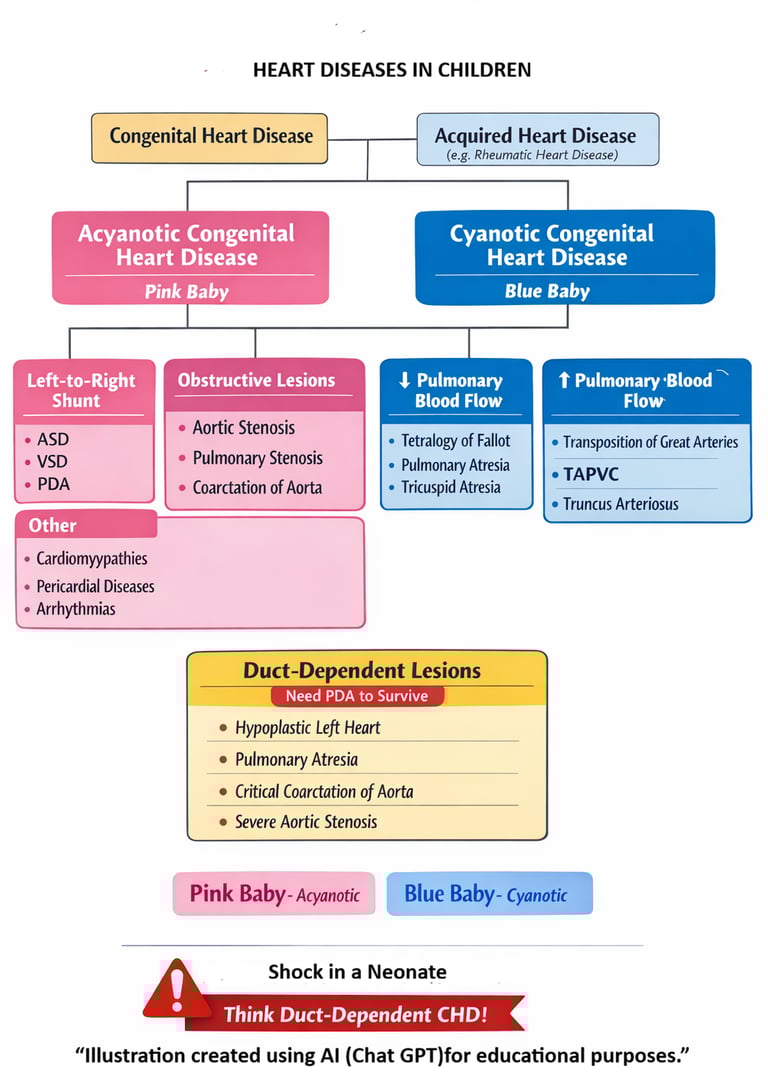
Before we discuss anything further let us have a quick look at the classification -